

Iconic Etchells class still going strong after almost sixty years
Skip Etchells was bitterly disappointed when his innovative 30-foot keelboat was not selected for the Olympics back in the sixties. However, Etchells drew great satisfaction from the fact his breakthrough creation spawned a highly successful one-design class with a loyal following decades later.
As the International Etchells Class prepares to contest its 47th world championship, some of the greatest sailors to ever step foot on the boat reflected on its enduring popularity.
A typically talent-laden fleet of 63 boats are entered in the AON 2023 Etchells World Championship, being held on Biscayne Bay in Miami. Skipper Ante Razmilovic and his Swedish Blue (GBR 1438) team will be looking to repeat as world champs after winning last year in Cowes, Isle of Wight.

2022 Etchells World Champions, SWEDISH BLUE © PKC Media
Skippers Marvin Beckmann, Steve Benjamin and Jud Smith are among the past world champs looking to dethrone Razmilovic. Numerous other former world champs, including Bill Hardesty and Skip Dieball, are competing as crew this time around.
Such a star-studded assemblage is typical at Etchells Worlds as the class has consistently attracted America’s Cup competitors and Olympic champions. Gary Jobson, tactician for skipper Ted Turner aboard Courageous when it successfully defended the America’s Cup in 1977, said Skip Etchells should be applauded for developing a design that has remained relevant since first being launched in 1966.
“It’s a boat that has been around a long time. Almost 60 years and it’s still going strong,” said Jobson, one of many National Sailing Hall of Fame members who have raced the Etchells.
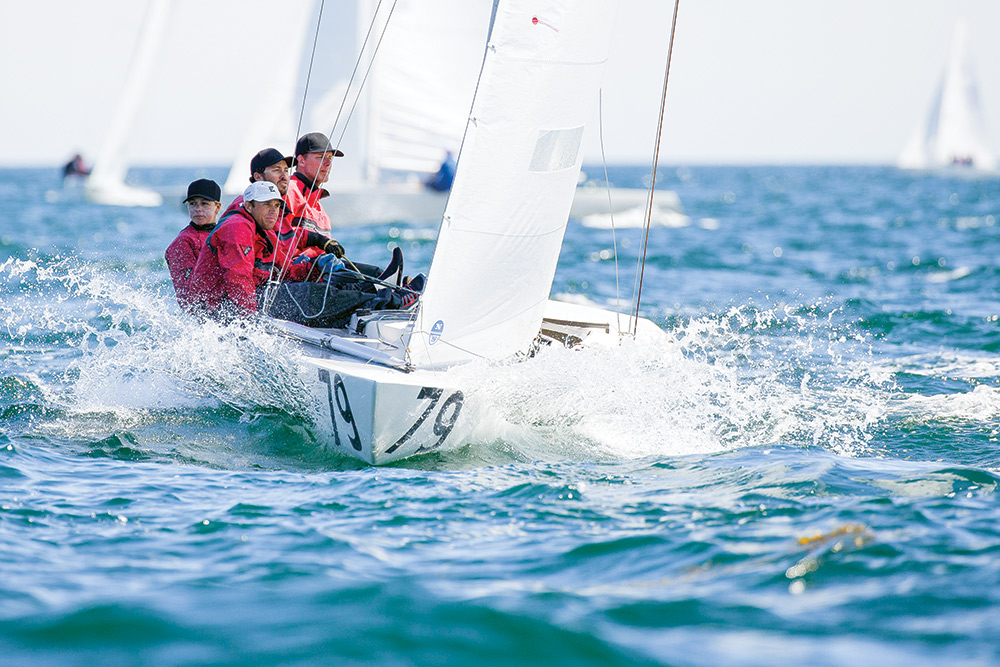
Bill Hardesty, with crew Taylor Canfield, Stephanie Roble and Marcus Eagan winning in Newport, RI in 2015. Photo: Sharon Green
“I think the Etchells has stood the test of time because it’s a boat that is extremely tactical, interesting to tune and exciting to sail. It’s a class that has always produced great racing because there is not much difference in speed no matter how good you are.”
Jobson first climbed aboard an Etchells in 1975 while coaching at the United States Merchant Marine Academy. He and a couple of Kings Point sailors secured the Long Island Sound Match Racing Championship, beating Bill Cox in the finals. Cox skippered American Eagle when it lost to Constellation in the America’s Cup Defender Trials in 1974.
Jobson has been racing the Etchells on and off for four decades, citing a third-place finish in the 2005 North American Championships behind Smith and Dennis Conner as his most notable result.
“You know you are going against great competition every time you enter a major regatta,” he said.
Any veteran Etchells sailor knows well the origins of the class, but for those that don’t the back story is important. Tim Etchells detailed the entire episode from his father’s perspective in an article written for Sailing World. The tale began in 1965, shortly after Skip Etchells had moved his boatyard to Stamford, Connecticut. It all began when the International Yacht Racing Union (IYRU) announced it was searching for a new three-person keelboat to become an Olympic class. Skip Etchells accepted the challenge and designed a boat to what he termed a “very simple rule, very good for the imagination.” His creation was 22 feet on the waterline and had a 4-foot, 6-inch draft, 3,700 pounds of displacement and 310 square feet of sail area.
Etchells would later say the IYRU had invited a “vwholesome, heavy-weather boat” and that is what he delivered. He named the boat Shillalah and it was shipped to Kiel, Germany late in the summer of 1966 to compete in the IYRY three-man keelboat trials. A total of eight boats were entered, including one named Conqueror that came off the boards of another renowned Connecticut-based naval architect named Britton Chance. Also in the field were two boats designed by E.G. van der Stadt of the Netherlands, a pair of German entrants and the Soling — an existing class from Norway. All but the Soling were designed and built to fall near the maximum size outlined in the IYRU guidelines.
Shillalah went on to win eight of 11 races with Skip Etchells later explaining that human mistakes and equipment breakdowns were the only reasons his boat did not make a clean sweep. Conqueror, sailed by Chance and George O’Day, won the other three races. None of the other boats were ever in contention.
In a report about the IYRU committee proceedings, chairman Frank Murdoch wrote: “The consensus was that Shillalah very closely approximated the kind of boat visualized when the proposed class was discussed and the limits determined.”
However, Murdoch included a statement that would presage the final outcome: “A boat such as the Soling reveals the unexpected possibility of a high performance in all its aspects coupled with a low initial cost.”
Etchells had a sense of foreboding about the entire process and his instincts would prove valid when the IYRU ordered a second set of trials to be held in Travemunde, Germany.
“Dad was disheartened and wondered whether the decision signaled the ‘fix was in,’ that an American boat couldn’t get a fair shake,” Tim Etchells wrote in his Sailing World story.
Bob Bavier, an America’s Cup veteran who was executive vice president of Yachting Magazine, was the lone American member of the IYRU committee. He contacted Skip Etchells and suggested building a fiberglass replica of the original design.
Etchells was a busy man in those days, having designed and built some of the fastest Star and Lightning class boats of the era. However, all spare time was devoted to building a mold that would lead to the launch of Shillalah II, which was sent to Travemunde in August, 1967.
Conqueror competed in the second set of trials as did the Soling, while van der Stadt entered a new design. Also participating in some of the 13 races held were a 5.5 meter and a Dragon. In a virtual repeat of the summer before, Shillalah II won 10 races and Conqueror won three with the 5.5 meter proving competition in extremely light air.
Despite the results, the on-site “Observation Committee” somehow concluded that the Soling best fulfills the requirements issued for a new three-man keelboat and proceeded to recommend that Jan Herman Linge design to the IYRU.
“The decision was devastating to Dad, who felt he’d been blindsided,” Tim Etchells wrote. “There was no doubt in his mind the Soling had been chosen long before the trials began.”
While the Soling was ultimately selected to replace the Dragon as an Olympic class. However, the story of what would initially be known as the Etchells 22 was just starting to be written.
THE BIOGRAPHER
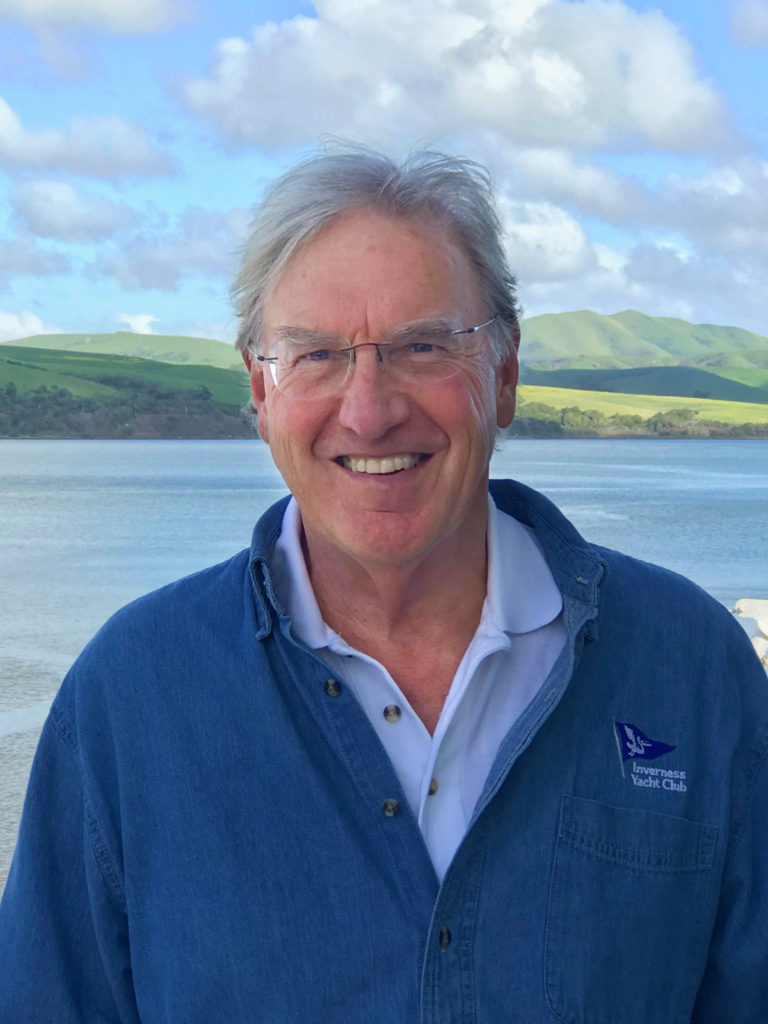
Bill Barton
Bill Barton grew up at American YC in Rye, NY and frequently visited The Old Greenwich Boat Company in Connecticut when Skip Etchells built boats at his yard there. Barton admittedly “idolized Skip Etchells,” whom he got to know while serving as head instructor at Rocky Point Yacht Club. He taught sailing to Tim and Annie Etchells at the club where Skip was a longtime member.
“Skip built the most beautiful Star boats ever seen with wood hulls and laminated decks,” said Barton, who is writing a book about Etchells and his yacht design career. “All his boats were renowned for both their speed and quality of workmanship.”
Etchells founded the Old Greenwich Boat Company in 1948 after leaving Sparkman & Stephens in New York. He would build 360 Star boats and the first 50 Etchells. Barton recalled that Etchells was “angry and disillusioned” about the IYRU decision to not recommend his three-man keelboat for the Olympics. “Basically, Skip was duped because the IYRU asked for a specific boat then went with something else entirely,” Barton said.
However, Skip took solace in the fact his breakthrough design developed a strong following among members at American Yacht Club and Larchmont Yacht Club. Those folks were responsible for the first order for 15 Etchells the Old Greenwich Boat Company received in December, 1967. The initial cost of the boat was $6,000.
In the summer of 1968, Etchells asked Barton to sail Shillalah in regattas on Long Island Sound to help promote the fledgling class. “Drag your foot in the water,” Skip said, not wanting the speedy prototype to win easily and discourage potential owners.
Barton noted that Etchells fleets quickly sprung up all around the country. The Etchells became popular in California and there was a time when San Francisco, Newport Beach and San Diego had 25 boats or more.
“The Etchells developed great local fleets in its heyday,” Barton said. “The San Francisco fleet used to have 50 races per season and there were consistently 18 to 25 boats on the starting line.”
Barton spent 35 years in the class and raced with some outstanding skippers along the way. He has a thorough grasp of Etchells history and believes the boat’s peak popularity came in the 1990s. Skip Etchells died on December 20, 1998 at the age of 87, not too long after the world championships held at Eastern Yacht Club in Marblehead, Massachusetts attracted a whopping 102 boats.
Canadian Dirk Kneulman captured the 1998 world crown, while Russell Coutts and Brad Butterworth of New Zealand placed second. Peter Duncan took third with Barton as part of the crew. There were 50 different fleets around the world, including 25 in the United States, in 1998.
Barton is one of many class veterans who believe the enduring popularity of the Etchells is the result of numerous factors. First, the boat remains fast, fun and fairly challenging to sail. Second, the class has always attracted some of the best sailors in the world, ensuring that major regattas are extremely competitive. Strong class leadership has guaranteed fairness and uniformity.
“There has always been tremendous leadership within the class — people committed to enforcing the rules and maintaining standards,” he said. “It’s a class filled with great people who share tremendous respect and camaraderie.”
Over the decades, Barton has seen periodic changes to Etchells class rules. A big one came in 1992 when class governors voted to allow four sailors on the boat as long as the overall crew was within the weight limit.
That notable change had been talked about in 1991 when Bill Munster was the class general manager. Munster and Norm Reynolds crewed for Dennis Conner and they were the heaviest team on the circuit at the time.
Munster convinced the governors to hold off implementing the four-person crew allowance then helped Conner capture the 1991 Etchells World Championship in heavy air off San Francisco.
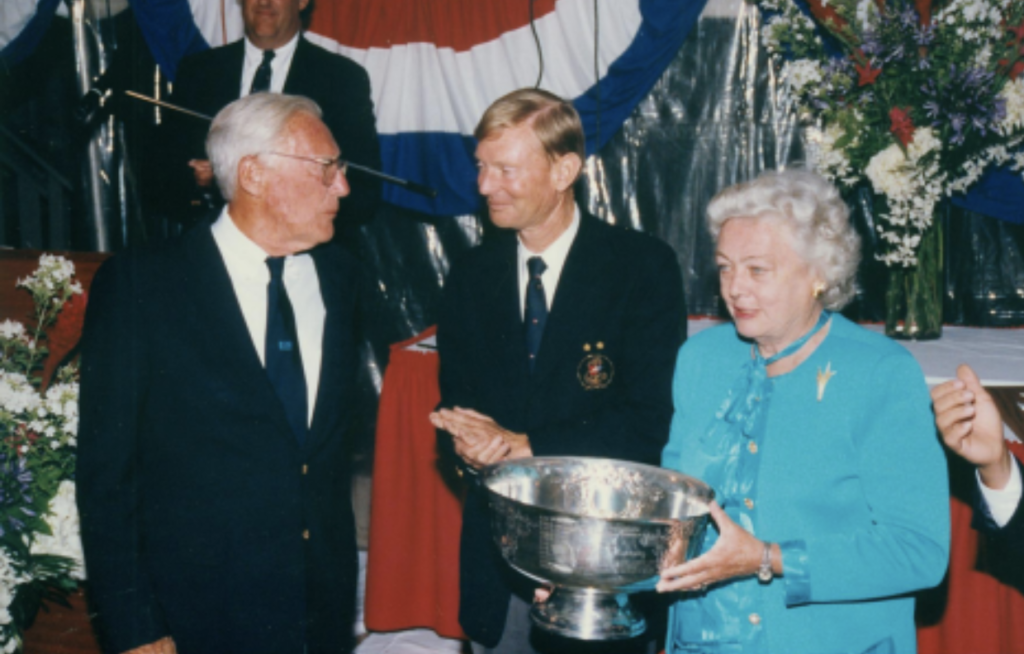
Skip and Mary Etchells flank San Francisco yacht club commodore Ed Thompson during the awards ceremony for the 1991 world championship that was won by legendary yachtsman Dennis Conner.
The weight limit of 628.3 pounds went into effect the following year. For a long time, class rules allowed owners to buy only three new sails per year — one main, one jib, one spinnaker. It was a provision that was strictly monitored. That rule was recently repealed and now owners can buy an unlimited number of new sails. Because the initial IYRU design brief stated that prospective boats should “not be overly athletic,” Skip Etchells purposefully did not set up the cockpit for hiking. Over time, crew members figured out how to hike without straps, which was difficult and taxing on the body.
Class leaders relented and approved having a line coming off the Barney post that enabled a crew member to hike with the stipulation that it could not be beyond mid-thigh.
THE BOATBUILDER
Dirk Kneulman is a prominent figure in Etchells class history, both as a competitor and a boatbuilder. The Ontario native was introduced to the boat when his father started building Etchells in 1967 at the family-owned Ontario Yachts.
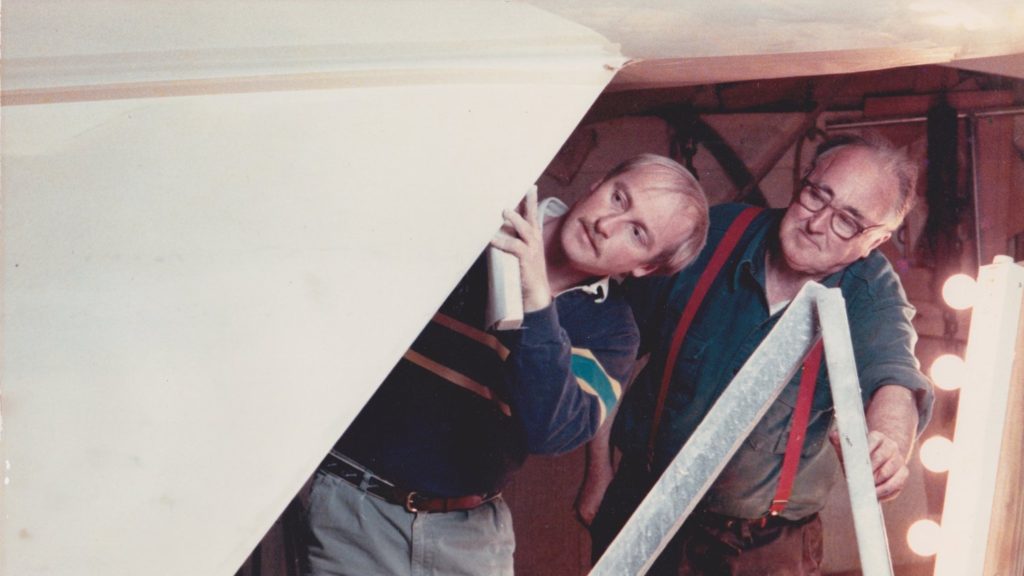
Dirk Jr. and Dirk Sr. circa 1987. Credit: The Spectator
The younger Kneulman sailed Snipes for years, but started racing the Etchells in 1979 as a means to network within the class for business purposes. He placed sixth at the 1979 Etchells Worlds that were held out of Royal Canadian Yacht Club in Toronto.
From that time on, Dirk Jr. ran the Etchells shop of Ontario Yachts and the company earned a reputation for building fast, beautiful models.
“Our flagship has always been the Etchells,” said Kneulman, who would wind up running Ontario Yachts from 1986 through 2019 until it was sold to a couple longtime employees.
Kneulman started crewing for Conner in 2006 and served as his tactician for two world championships. He worked both the middle and bow for the three-time America’s Cup champion.
“I figured I would sail with a legend and see what I could learn. DC did teach me quite a few things,” Kneulman said. “Dennis is a great guy to crew for and he really loved the competition in the Etchells class.
Switching to a crew role gave Kneulman a new perspective as he realized the front of the boat was not very ergonomic. That prompted him to introduce numerous changes during the building process to make life more comfortable for the crew such as angling the recesses in the decks so the control leads were directed toward the crew member using them.
Kneulman also worked closely with legendary Etchells sailor Dave Curtis on various building techniques. Curtis brought a fresh perspective as a professional sailmaker who was an engineer by education and fiddled with boatbuilding as a hobby.
“I think Dave is the greatest Etchells sailor ever and I very much valued his opinion,” Kneulman said. “We would collaborate on ways to improve the boat and he was instrumental in preventing me from getting complacent. He was always asking questions, making suggestions and wondering if there was a better way to do this or that?”
Kneulman is one of only a few sailors to claim an Etchells World Championship as both skipper (1998) and crew (2006 with Jud Smith). He will be competing in this month’s worlds as crew for Bermudian Mark Watson on Tiburon (BER 1467).
The 67-year-old Kneulman has been around long enough to remember when Skip Etchells would come out on the water to watch the action whenever the worlds were held in the New England region. He recalls competing at a worlds that featured three America’s Cup winning skippers in Conner, Coutts and John Bertrand.
“Every time I sail an Etchells, I’m struck by just how spectacular the boat is. Skip absolutely nailed it on so many levels, from the length of the boat to the position of the keel,” Kneulman said. “In my opinion, the reason it became such a great class is because it wasn’t an Olympic boat. Most Olympic classes go in and out of style. The Etchells carries on and is still going strong.”
THE MASTER

Dave Curtis courtesy; National Sailing Hall of Fame
Dave Curtis bought his first Soling in 1969 after it was announced as an Olympic boat. He competed in the United States Olympic Trials five times between 1972 and 1992 in that class.
As a professional sailmaker, Curtis realized he needed to get involved with the burgeoning Etchells class as well and bought his first boat in 1975. Curtis Sails became a dominant player in the Etchells class due largely to the loft owner’s success on the racecourse.
“I saw the class was growing significantly and attracting a lot of talented sailors,” he said. “I felt like I had to go to all these regattas to promote my sails. I was winning a lot so I sold a ton of sails.”
Curtis captured the first world championship in which he competed, sailing Big Red to victory off Newport, Rhode Island with Bob Danforth as co-skipper and Bill Kull as crew. He would go on to secure seven world crowns, which remains a class record.
Winning worlds in 1981 was particularly special for Curtis as the regatta was held in his hometown of Marblehead. Bob McCann and Jamie Hardenburgh, who crewed for Curtis for three of his world championships, also hail from Marblehead.
Now 77 years old and retired from sailmaking, Curtis recalls specifics about almost every Etchells Worlds he attended. He still gets annoyed about finishing second four times in worlds held in Australia.
“I never won in Australia, which was really annoying,” Curtis said. “We should have won at least a couple times. Something crazy always happened whenever we went to Australia.”
Curtis was beating Ian Murray off Sydney in 1984 when one of the mishaps took place. Racing on the final day was held in high winds and heavy seas and crew member Bruce Dyson fell out of the boat after it launched off a massive wave.
Curtis also regrets the turn of events that caused a runner-up finish to John Savage in 1988 off Newport, Australia.
A fonder memory came in 1992 when the worlds were held in Larchmont. It marked the first time Curtis competed against Conner, who was the defending champion.
“I knew Dennis had a lot of weight in the boat and did not want that to be the difference. I needed another heavy guy, so I picked up Tom Olsen who was a veteran Star crew,” Curtis recalled. “We went head-to-head with Dennis and sailed past him repeatedly. It felt good.”
Having sailed both the Soling and Etchells extensively, Curtis is qualified to weigh in about the infamous IYRU decision back in 1968.
“The Etchells was a faster boat than the Soling, no question about that. However, the Soling was a better boat for the Olympics, in my opinion,” Curtis said. “I think the one mistake Skip Etchells made was not having hiking straps. I’ve got a bad back because of the Etchells from hiking so hard.”
Curtis also holds the class record for most first place finishes at the world championships with 27 in total. Fellow Marblehead professional Jud Smith is second with 14.
“Dave had a great technical mind and a very strong competitive desire to win. I doubt his accomplishments in the Etchells class will ever be matched,” said Kneulman, who is proud that Curtis always sailed a boat built by Ontario Yachts.
THE NEWCOMER
Acclaimed professional sailor Steve Benjamin made his mark in the 470 class, capturing the silver medal at the 1984 Olympics in Los Angeles. He’s enjoyed tremendous success in a wide range of big boats, most notably with a Carkeek 40 named Spookie, and is a former Rolex Yachtsman of the Year.
Benjamin came to the Etchells class later in his career, first competing in what was then known as the Jaguar Series in 2014 aboard a borrowed boat. “It was kind of a whim. Tom Lehan called and said my boat is available, so why don’t you sail one of the winter regattas,” Benjamin said.
There were five spots available for the upcoming world championships and Benjamin wound up being the top qualifier. He bought Hull Number 1228 and promptly finished 26th at the worlds held in Newport, R.I.
“That was very disappointing and I realized I really needed to get my act together in order to compete in this class,” Benjamin said. “We put together a more sustained effort for the 2015 worlds in Hong Kong and finished second, which was encouraging.”
Benjamin was runner-up for a second straight year in 2016 when legendary Australian skipper John Bertrand claimed his second world crown out of Cowes, Isle of Wight in Great Britain.
He bought a brand new boat specifically for the 2017 world championship held on San Francisco Bay and finally broke through with a talented crew consisting of Dave Hughes, Ian Liberty and Michael Menninger.

Steve Benjamin, Michael Menninger, Ian Liberty & Dave Hughes win the 2017 Etchells Worlds in San Francisco © Leslie Richter / Rockskipper Photography
Benjamin has another new boat (Hull Number 1511) for this year’s world championships and will have Mike Buckley aboard as tactician, Hughes as spinnaker trimmer and Liberty as headsail trimmer. As a four-man team, they must weigh an average of 157 pounds.
“I’m 67 and I have to go to the gym every morning to get down to the right weight,” Benjamin said.
Benjamin captured the Etchells European Championship last year and has a couple North American titles to his credit. He won the winter series held on Biscayne Bay for five straight seasons.
“I love everything about the Etchells starting with the caliber of competition, which is top-notch. It’s really tough to beat the Etchells as far as high-end sailors,” Benjamin said. “I love the boat itself because it’s really tweaky, which is right up my alley. I like fiddling with every control knowing that every adjustment on every turnbuckle makes a noticeable difference.
“Also, I’ve always liked sailing as a team going back to my days in the 470. That was a two-man team and this is a four-man team.”
THE VENUE
Miami and Biscayne Bay have become an important part of the Etchells class story. It all started in 1998 when the winter series was established and it now features five events: The Piana Cup, Sidney Doren Memorial, Florida State Championships, the Midwinters East Regatta, and the Coral Reef Cup.
Etchells Fleet 20 serves as organizing body with Biscayne Bay Yacht Club the host facility. Winner of the first four events series is presented with the Schoonmaker Cup, the final event, the Coral Reef Cup is scored separately. Dave Brennan was principal race officer for what is now known as the Etchells Biscayne Bay Series from 1999 through 2017.
“I think the ability to get everyone together in Miami on a regular basis has been a big boon for the class,” said Marvin Beckmann, the 2013 world champion. “Everyone in Miami is very welcoming, the facilities are outstanding and the race management is terrific.”
Remarkably, this will mark the first time Miami has ever hosted the Etchells World Championship. It’s all hands on deck in Coconut Grove with Coral Reef Yacht Club and Shake-a-Leg Miami helping out.
Brennan is serving as principal race officer, while Jeff Nehms and Chris Lanza are the regatta co-chairmen. They, along with a dedicated team of volunteers, have been working for a year to plan and execute the regatta.
“The magnitude of work involved in organizing a world championship is unbelievable,” said Brennan, noting the pre-regatta measurement process is the most strict and thorough he’s ever seen.
“All the boats at a world championship are as identical as can possibly be. That’s a big part of the staying power of the Etchells. Class leaders have gone out of their way to make sure it is truly a one-design class,” Brennan added.
“When you go to an Etchells regatta, it’s not so much about the boat as about the sailors.”

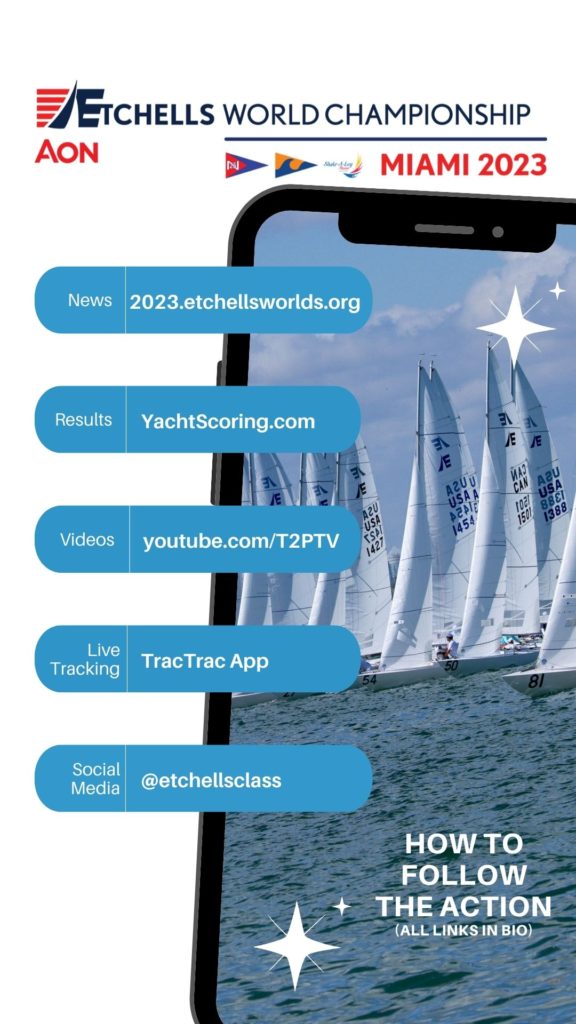
How to follow 2023 AON Etchells World Championships Miami:
- All information is below is linked from 2023.etchellsworlds.org
- LiveTracking: https://tractrac.com/event-page/event_20230411_AONWorldCh/2540
- Social Media: @EtchellsClass (Facebook, Instagram, Twitter)
- Entry List & Results: https://yachtscoring.com/emenu.cfm?eID=15513
- Daily Video Recaps: https://www.youtube.com/T2PTVSailingOnDemand
